Our president, Glenn, WNØEHE, will be stepping down when his term expires on December 31 of this year. After living in the Denver area for many years he decided to move to southern Arizona and bake his bones in the sun.
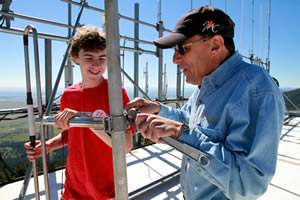
Taking time to mentor the next generation. ((L) Skylar, KD0WHB, and (R) Glenn, WN0EHE)
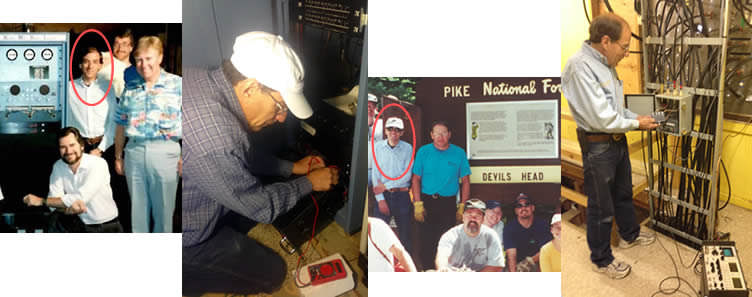
It’s hard to think of a person who has had a larger impact on the RMRL’s success. Glenn tells how he received a call from Warren, NØFVG in 1985 asking him to go to Squaw Mountain and help with the 146.94 MHz repeater – just once. That one-time trip turned into more than 30 years of service to the RMRL. In addition to filling the elected office of president, Glenn acted as head of the club’s technical committee and was a repeater trustee for many years. He was the designer and chief builder of our repeater systems and always willing to take time out of his personal schedule to make trips to the sites and fix problems so the repeaters were available for the rest of us. Wow!
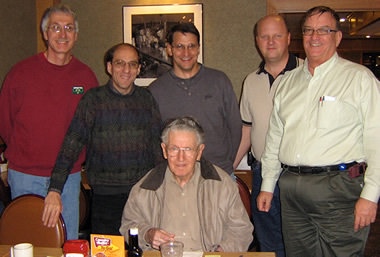
RMRL Board at the 2008 Christmas party. (Standing, L-R) Joe WT0C, Glenn WN0EHE, Ron N0MQJ, Ed N0MHU, and Richard WB5YOE. (Sitting) Jim W0LGF (SK)
Glenn says one of the most difficult parts of his decision to relocate was leaving the RMRL and all of the people who have made it such a great organization. He indicates he’ll also miss working on the innovative projects undertaken by the club over the years, including repeater rebuilds, the amateur paging project, WWVB set-time project, autopatch call logger, and modifications to the S-COMM 7K repeater controllers to make new speech synthesizer words tailored just for RMRL use.
It’s no surprise that Glenn has had experiences over the years leading to amusing “war stories”. One of the better ones involved an emergency trip to repair repeaters in the middle of winter, which didn’t seem like much fun at the time. He and Ed, NØMHU, snowshoed up Squaw Mountain carrying test equipment and a new power supply. Glenn remembers remarking “It’s a good thing that this is our hobby because nobody could pay us enough to do this!”.
We will certainly miss Glenn and his leadership but wish him the best in the next phase of his life in Arizona!
You have all heard this portion of the Monday night nets:
“We have a balloon repeater with a receive frequency of 445.975 MHz and a transmit frequency of 147.555 MHz. This repeater is flown periodically by the Edge of Space Sciences balloon launch group.”
But maybe you’ve never gone on to look up just what the Edge of Space Sciences balloon launch group is or does. From their web site:
What is EOSS
Edge of Space Sciences (EOSS) is a Denver, Colorado based non-profit organization that promotes science and education by exploring frontiers in amateur radio and high altitude balloons.
Since its first flight in 1990, EOSS has grown its volunteer membership’s numbers and skills over the course of more than 200 launches, ascents into the stratosphere and payload recoveries. Today, it is widely recognized as one of the premier organizations in its field.
EOSS was incorporated in the State of Colorado in 1991 and is recognized by both Colorado and the U.S. Government as a 501(c)(3), tax exempt, scientific and educational organization.
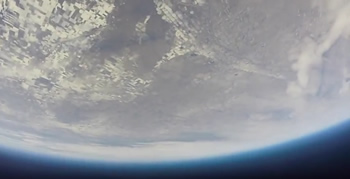
Falling back to earth.
What We Do
Our members utilize amateur radio and balloons to advance scientific study of the upper atmosphere. We regularly work with educators, offering valuable opportunities to enhance their students’ studies of science, mathematics and technology through real, hands-on experience.
EOSS has conducted as many as thirteen balloon projects in a year, sending radio-equipped payloads deep into the stratosphere over eastern Colorado. Our typical apogee of 95,000 feet is above 99% of the Earth’s atmospheric mass, where the sky is black and the highest clouds remain far below. VHF and UHF radio signals transmitted from this height are received as far as 400 miles away!
Sometimes called the “Edge of Space”, this largely unexplored territory offers a wealth of opportunities for scientific observation and has even served as a reasonable approximation to outer space for testing prototype spacecraft. Gas balloons are the most practical means to get there, since rockets can visit it only briefly, and it is unattainable by ground-based aircraft. Because of the low cost of balloon flight expendables and recovery of payloads, one local high school teacher characterized EOSS as the “Poor Man’s Space Program”.
Individuals have many opportunities to exchange ideas with their fellow members. A monthly meeting is conducted the second Tuesday of each month.
On each remaining Tuesday, a radio meeting on-the-air, or net, is conducted at 8 P.M. During this “net” weekly updates on EOSS projects and news bulletins concerning amateur radio balloon projects around the country are discussed.
Please go to eoss.org for more information. See the current schedule in the text box marked “EOSS Upcoming Flights.”
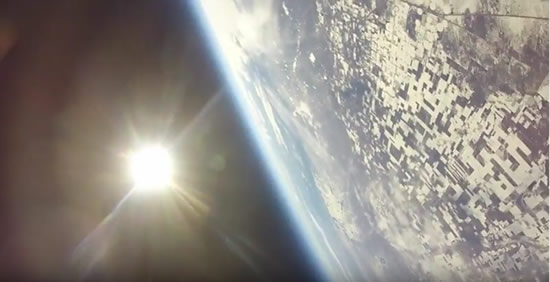
They have flown many interesting missions over the years, with payloads from a variety of sources, from university students down to elementary school students. Check the EOSS YouTube channel for mission videos. RMRL member Skylar, KD0WHB, was involved in a mission when he was attending the Denver School of the Arts. You can see several videos from mission EOSS-218 on YouTube, but this short one captures some amazing images as it reached just over 94,000 ft. before bursting and heading back to earth.
Our 449.450 repeater has a new trustee. Richard, WB5YOE, has been the trustee of this repeater for many years. He is leaving the area to pursue employment opportunities elsewhere. Dunnigan, K1DUN, has agreed to assume the trusteeship.
We’re very sorry to see Richard go. He is a long-time RMRL member and has always been available to assist the club with whatever needs doing. In addition to his trusteeship, he has served on the technical committee, organized club picnics, assisted with hamfests, climbed towers, and many other things too numerous to list. Thanks Richard for all your help over the years – we wish you the best in your new endeavors!
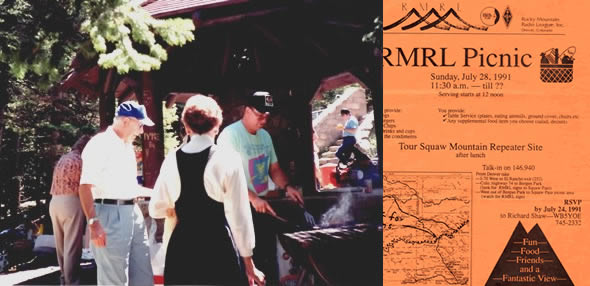
Richard, WB5YOE, cooks at a 1991 RMRL picnic.
Dunnigan, thank you for stepping up and supporting the club in yet another way!
On June 11, 2016 a group of RMRL volunteers removed our 449.125 MHz repeater from its location at the Devil’s Head fire lookout in Douglas County. It was a coda to the 16-year operation of the “site west of Sedalia” for the RMRL club.
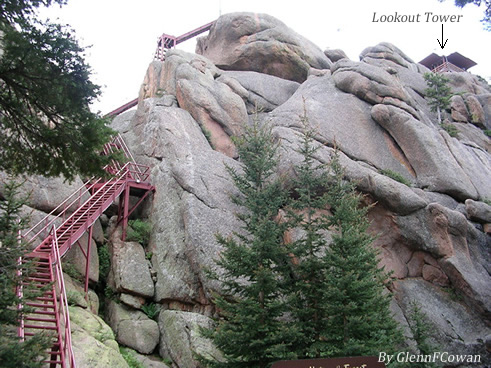
The installation team at the bottom of the steps up to the tower.
Former RMRL member Warren, N0FVG approached the Forest Service in 1999 with a proposal to place a club repeater at Devils Head. Warren and Joe, WT0C worked with Forest Service personnel and secured a permit in August 2000. A team of RMRL volunteers installed the repeater in September 2000. The equipment was carried 1.4 miles up the trail and the last 143 steps to the tower on a gurney. Ed, KA0ZAS was in charge of the repeater installation.
The devil is in the details: 143 steep stairs tops the easy hike up the mountain. Total round-trip is 2.8 miles; bottom to top is a 940 ft. rise in elevation.
In its early years, the 449.125 MHz repeater was used by the Front Range Electronic Direction Finders (FREDF) group for training and coordinating aircraft ELT signal searches. Perhaps the repeater’s finest hours came in 2002 when it was utilized extensively for health and welfare traffic during the Hayman forest fire. The repeater’s excellent coverage of the fire area to the west and the populated Front Range to the east made it ideal for this purpose. More recently the repeater has supported general club communications.
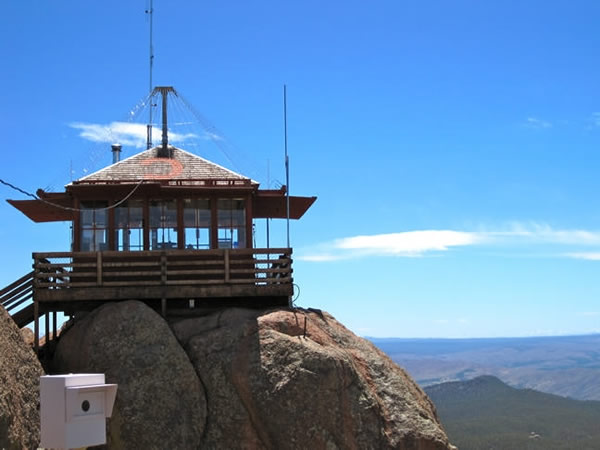
The view from the top of Devil’s Head is stunning. A view of the tower from the north after the repeater was installed. The repeater’s antenna is at the far right. Devil’s Head Lookout is the last of the seven original Front Range Lookout towers still in continuous use.
On June 11, 2016 the repeater was removed. This was done because the U. S. Forest Service declined to renew the club’s permit. Brian Banks, District Ranger of the South Platte Ranger District, indicated amateur radio is not consistent with the fire lookout’s use and detracts from the public’s enjoyment. He also expressed concern about interference. Mr. Banks denied our permit renewal application despite the fact there have been no aesthetic or interference complaints involving our repeater in the almost 16 years it was at Devils Head.
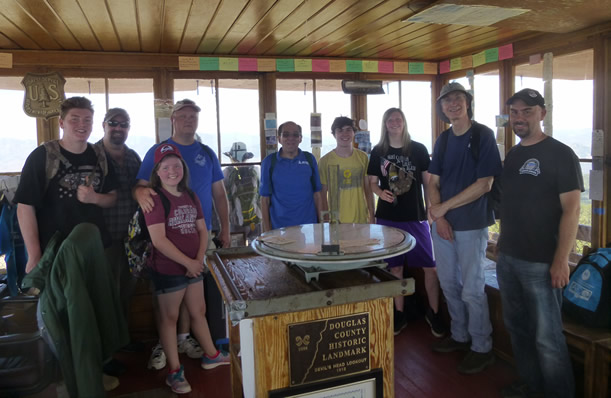
The removal team from left to right: Graham (K1DUN’s son); Dunnigan, K1DUN; Ed, N0MHU and daughter Beth; Glenn, WN0EHE; Skyler, KD0WHB; Anna, W0ANT; Joe, WT0C; Mike, KI0GO. Not pictured: Mimi, N0KRB who took the photo.
As of this writing, the RMRL is looking for a new home for the 449.125 repeater site. If you know of a location that may be suitable, please inform any of the officers.
Many thanks to the volunteers who disassembled the repeater and antenna and transported them down. A shout-out also to the Columbine LDS church youth group who gave us much-needed assistance in carrying out that heavy cabinet!
Last week (first week of June, 2016), the Squaw Mountain site was left without power following a lightning storm. This took both RMRL repeaters (146.940 and 449.450) off the air, including for the June 6th weekly net. The backup generator failed to start automatically. When commercial power returned two days later, the replacement power company transformer put out 160 VAC instead of the normal 120 VAC and damaged several pieces of equipment at the site. Fortunately, RMRL’s well-designed system prevented the increase in power from taking out any critical or expensive components.
Glenn (WN0EHE) and Dunnigan (K1DUN) made a trip to the site on Sunday, June 12th. It was discovered that a single MOV in the power line filter had blown, thereby interrupting the AC current overload and protecting the rest of the system. We replaced some transient protectors and were back on the air. The 146.940 and 449.450 machines are, once again, fully operational.
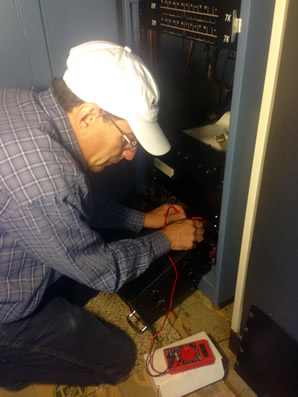
Glenn (WNØEHE) troubleshooting the system on June 12th (2016)This little AC power line filter had to be replaced.
4/22/2016: IRLP Node 335(0) has been moved back to the 145.34. (Thanks to Mike, KI0GO, and his snowmobiles.) All is back to normal in RMRL world.
4/12/2016: Due to a technical problem, the IRLP Node 335(0) has been temporarily moved over to the 145.430 repeater. The road to the 145.34 repeater is impassable until further snow melt, so no firm date can be set at this time as to when it will be moved back to the 145.34.
Operationally everything is the same, it is just a different frequency.
Recollections of Steve Smith, K0WLN, (one of the original founders) and Glenn Cascino, WN0EHE
Steve and about a half-dozen or so other people started the club in the late 1960’s. When asked why they didn’t join an existing club, Steve responded that they were a young group and didn’t feel all that welcomed into some of the other, more established, clubs. They wanted to start a group that made everyone feel welcome.
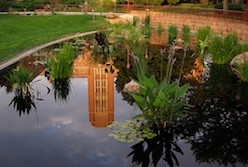
RMRL’s first repeater location: DU library tower
Steve worked at DU in the Physics Department and started the club off with a repeater in the three-story library tower at DU. At the time, Steve was working on infrared projects for the Air Force and flying 1,000-pound equipment balloons that needed tracking, hence his interest in communications and ham radio. He had a fully-equipped machine shop available to him for his work projects. A lot of ham equipment and accessories were home-built in those days, so being able to machine his own parts gave Steve a big advantage in setting up and deploying equipment.
The other core founders were also mostly technically inclined, many worked at local television stations or elsewhere in the communications field. The businessmen of the group helped get the club paperwork done, establishing it as a 501(3)c, and handling other legal matters along the way.
At the time, when crystal radios came from the factory, the most popular frequency was 146.94 and 146.34. That is why you will find so many early clubs set up repeaters in those frequencies – that was the main option unless they had the resources to add crystals tuned to different frequencies.
The first club repeater was the 146.34/94. That’s not a typo. The nomenclature for referencing a repeater at the time included both the input and output signals. The input was 146.340, with an output of 146.940, thus the repeater was referenced as the 146.34/94. Today we know it as the 146.94 repeater.
The original was a vacuum tube radio, a Motorola FMTRU-80(D). This was a top-of-the-line mobile radio, originally designed and manufactured in the 1950’s. Power supplies for base stations were problematic: the manufacturers would rack-mount a bunch of mobile power supplies and call it good. Steve made good use of his machine shop and built the power supplies himself.
Steve’s friend, Bob Swanlund, also a ham, worked for the Colorado State Patrol and founded the station at the top of Squaw Mountain. Bob’s wife, Margaret, worked for the Forest Service. Squaw Mountain was the site of the Colorado State Patrol radios, as well as communications systems for several other government agencies. It was a good partnership: Margaret did the fire-lookout job while Bob took care of all the communications equipment on site.
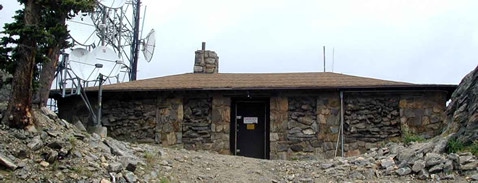
Bob and Margaret Swanlund’s home atop Squaw Mountain. No longer used as a residence, it is now known as the “House of Radios” hosting many repeaters.
Bob and his wife worked with the government to build a home at the top of Squaw —an endeavor that took 16 years to complete. Although it lacked running water, it was a great location for a ham radio repeater. Bob invited his friend Steve to locate his repeater up there. So, after about a year at the DU library location, they moved the repeater to the basement of Bob’s house and put the antenna on the mountain. With the antenna cantilevered out about 5’ from the tower, they had coverage in all directions. Lacking a commercial duplexer, they set up a dual-antenna repeater. Steve said there was nothing behind the antenna and the radio footprint was amazing.
Thus, the Rocky Mountain Radio League became the first ham radio club to have a repeater on Squaw Mountain. Which also helps to explain the club’s call sign: W0WYX. Why is that significant? Bob Swanlund’s call sign was W0WYX.
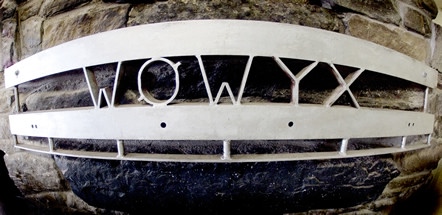
Affixed just above the fireplace in the House of Radios, this sign memorializes Bob Swanlund and the RMRL’s roots.